Consumption: “Who did they think was going to come and clean it up?”

Standard

In a short but interesting interview, Robin Nagle, a sanitation anthropologist studies what our trash says about us,

Q: What are some surprising things you’ve learned by analyzing garbage??

A: In affluent neighborhoods, I was profoundly impressed with how much good stuff rich people throw away.

via Trash is Her Treasure: Scientific American.

I guess I would rephrase that: she is impressed by how much stuff we buy in the first place that we don’t need.

No Grocery Stores

Standard

Quite often, a stark reality of being poor is that even if you wanted to do the right thing by your children, it’s damn near impossible to do. When The First Lady is being criticized for “anti-obesity” program, many in the media forget that it’s a political catch all that’s really a reductive way of knocking Michelle Obama’s focus on improving American childhood nutrition and food access for lower middle class and poor families. (video from whitehouse.gov)

You don’t have to be as wonky as Ezra Klein to realize that the problem that plagues the entire cities of Chester, PA and Detroit, Michigan is a horrific problem:

There are no chain grocery stores in all of Detroit.

via Ezra Klein – The scariest sentence Ive read today.

Klein found this showstopper in the Charles LeDuff article featured in Mother Jones about the death of Aiyana Stanley-Jones, a seven year old murdered in a botched SWAT raid being filmed for a reality show. “No grocery stores” as a the mark of the failure of a city is a horror story many south eastern PA residents find familiar. Many of us Philadelphians talk about how bad the problems are facing the residents and government of Chester, PA, the fact that a city with a population of 491, 489 people has no chain grocery store is a fact many of us use to drive the point home. Detroit has a population of 951, 270 people and no chain grocery stores.

Stand at the corner of Lillibridge Street and Mack Avenue and walk a mile in each direction from Alter Road to Gratiot Avenue (pronounced Gra-shit). You will count 34 churches, a dozen liquor stores, six beauty salons and barber shops, a funeral parlor, a sprawling Chrysler engine and assembly complex working at less than half-capacity, and three dollar stores—but no grocery stores. In fact, there are no chain grocery stores in all of Detroit.

via What Killed Aiyana Stanley-Jones? | Mother Jones.

Even though conditions aren’t as dire in most major cities, they still are far less than ideal. Rural and urban areas, that suffer from the lack of access (proximity, price and produce) to fresh food are called “food deserts”. Kansas City resident Sydnee Svejda, a single mom in the Budd Park neighborhood of Kansas City is profiled in the Kansas City Star:

A single mom, she spends two hours a day riding the bus to and from her job as a receptionist at St. Luke’s Hospital. Sometimes Svejda manages to pick up a few grocery items from the Cosentino’s Apple Market on her bus route. It’s easier than taking Sydnee and Xavier with her on weekend shopping trips, which can take more than two hours. But the bus lets her off on the wrong side of the street and she’s been cursed at by speeding motorists as she tries to cross multiple lanes of traffic carrying unwieldy grocery bags in her arms.

Svejda lives in what experts call a food desert: She can walk to the Taco Bell at the end of her block more quickly and easily than she can walk to the neighborhood supermarket. Roughly 2.3 million U.S. households live more than a mile from a supermarket and do not have access to a car. An additional 3.4 million households are one-half to 1 mile from a supermarket and lack transportation.

via Food deserts | In urban core, need for nearby stores is great – KansasCity.com.

Junk food quite often fills the void for the working poor and unemployed in these under served areas. Add in the fact that many schools feed children unhealthy food for lunch, supporting a healthier food supply is key.

Alan Simpson’s Wonderful Life

Standard

From Zandar over at No More Mister Nice Blog comes a quote from Obama Administration debt commission co-chair Alan Simpson:

But as the co-chair of President Obama’s debt commission, the Wyoming Republican said he’s been taking an unprecedented amount of flak for the commission’s draft proposals to help erase the nation’s $13.8 trillion debt.

“I’ve never had any nastier mail or [been in a] more difficult position in my life,” said the 79-year-old Simpson. “Just vicious. People I’ve known, relatives [saying], “‘You son of a bitch. How could you do this?'”

If, as he alleges, complaints about the deficit recommendations he co-authored are the worst things Alan Simpson has heard someone say to him, then Mr. Simpson should stop bitching. He has had a great life.

On losing Feingold

Standard

I know this is late, but I am not the biggest fan of Russ Feingold the legislator. He is a Democrat who often chose being correct on the Senate floor over applying the correct leverage in the Senate back rooms.

More recently, he’s done plenty of things that should have earned him more scorn from progressive activists. He joined the GOP in filibustering financial reform because he thought it should’ve been tougher on banks. What eventually happened? Well, Democrats needed an additional vote to break the filibuster, so they got Scott Brown to turn against the filibuster in exchange for an $18 billion giveaway to banks, mostly in his state. The net effect of Feingold’s filibuster was giving $18 billion to banks. This is the sort of thing that anybody with more tactical sense than a popsicle would recognize and then go along with the bill.

via Donkeylicious: Russ Feingold, Good And Bad.

Bernie Sanders, who is to the left of Feingold, illustrated a way to properly legislate for a left of center politician in the majority party in their chamber of congress. Due to the fact that Health Care Reform did not have Public Option, he threatened to withhold his vote from the 60 vote majority and used that leverage to get $11B in funding for Community Health Centers to be built across the nation. Community Health Centers are key to providing primary care for the working class and poor and reducing the costs of providing primary care.

The Dodd-Frank bill — named after Dodd and Rep. Barney Frank (D-Mass.), who ushered it through the House — passed by a vote of 60 to 39. Three Republican senators — Scott Brown of Massachusetts and Olympia J. Snowe and Susan Collins of Maine — joined 57 members of the Democratic caucus in support. Sen. Russell Feingold of Wisconsin was the lone Democratic opponent, saying the measure didn’t go far enough.

via Congress passes financial reform bill.

To contrast, consider the nothing Feingold got us from opposing the Fin Reg bill. Feingold extracted no compromise. He just refused to vote for the Dodd-Frank Fin-Reg bill because it didn’t go far enough. Feingold could not bring himself to find any compromise or additional provision that would have made the bill worth supporting. Scott Brown did. For his vote, Brown negotiated a removal of the $19 billion dollar fee to be charged banks to pre-fund the financial reforms without adding any money to the deficit. Instead Brown demanded that the costs of the Dodd-Frank finreg bill be offset by “spending cuts”.

Quite late in the committee’s negotiations, the Congressional Budget Office examined the near-final version of their bill and said that the bill contained about $19 billion in likely costs to taxpayers over time, and so under pay-go laws, that cost would have to be offset. Barney Frank inserted a tax on large banks and hedge funds to cover the cost. And this is what Brown opposes: A tax on banks to pay for the cost of a bill that regulates banks.

Instead, Brown is insisting that the committee find $19 billion in spending cuts to support the legislation. So the banks are getting a new regulatory structure meant to prevent another round of chaotic failures, but Brown doesn’t think they should have to pay for it. Instead, other programs and services should be cut.

via Ezra Klein – Scott Brown’s problems with FinReg.

That Scott Brown vote, had to be secured instead of Feingold’s. He could have taken the opportunity to negotiate something more progressive that wasn’t in the bill. Instead, he took his ball and went home and now the reform he didn’t like, is now the unfunded reform he didn’t like. Here’s Feingold talking about the major things FinReg didn’t do.

Yes it wasn’t complete, yes it wouldn’t have stopped the crisis of 2008, but it helped to begin the roll back 40 years of supply side economics and deregulation. Our consumers are better of with the foundation laid in the Dodd-Frank bill. It was a start to reformating how our government can safely regulate the financial industry.

Feingold took a lot of stands, like voting against the Patriot Act and TARP that really didn’t amount to anything except principled protest. His primary job was to legislate. His all or nothing principles actually resulted in a less favorable bill for Democrats and the American public.

A better buy post Midterm 2010

Standard

With Gov-elect Corbett, Sen-elect Toomey and House delegation and PA state legislature that is dominated by the GOP, any company tapping into Marcellus Shale deposits has probably seen it’s value increase which makes this a smart buy for Chevron and bad news for people who want to find out how much damage fracking actually does to water supplies before they poison even more water tables.

Atlas owns a 60% stake in a joint venture with India’s Reliance Industries to exploit the Marcellus shale gas deposit in Pennsylvania

It means Chevron has chosen to follow ExxonMobil and Shell, by entering the burgeoning US industry for shale – a rock deposit that produces natural gas.

Chevron will pay $3.2bn in cash and its own stock, and will also take over $1.1bn of Atlas’ debts.

via BBC News – Chevron buys Marcellus shale deposit owner Atlas Energy.

Christie’s Cuts

Standard

I’m glad people love his tough talk on saving money, because as a governor Christie makes cuts without examining the full extent of their damage.

The FTA had already agreed to spend $350 million on the project. In Monday’s letter, the agency said it was “immediately deobligating” about $79 million remaining from that amount.

At least one state, New York, is already making a bid for the federal cash that was scheduled for the tunnel project. Sen. Kirsten Gillibrand has asked that the $3 billion in federal funds designated for the tunnel be redirected to the Long Island Rail Road’s East Side Access Project and the construction of the Second Avenue subway line.

Assemblyman John Wisniewski, D-Middlesex, a longtime advocate of the ARC Tunnel project, said Christie’s decision means the state’s taxpayers are now left with a bill for a “tunnel to nowhere.”

“The governor famously throughout this has said he is not going to spend money the state doesn’t have. I wonder where he is going to get this money,” Wisniewiski said.

Citing the $400 million in “Race to the Top” education dollars the state lost as the result of an application error, Wisniewski said this is the second time the governor has cost the state federal dollars.

“We’re approaching $700 million” in money lost, Wisniewiski said.

via FTA bills NJ $271 million for cancelled rail tunnel – NorthJersey.com.

Thank You.

Standard
(video below: President Obama thanks Veterans in Seoul, South Korea)

Thank you to veterans and their families on this Veterans Day.

Latino Vote & the Democratic Senate

Standard

Latino Voters swung heavily Democratic in 2010 midterms. Adam Serwer concludes:

Latinos are so diverse culturally that the only reason they vote as a bloc at all is because they continue to have collective interests as Latinos. That has more to do with a shared experience of discrimination than a shared culture; the more immigration policy becomes pretext for targeting Latinos, the more likely they are to vote this way. That said, the victories of Republican candidates like Susana Martinez, Marco Rubio, and Brian Sandoval show that they can blunt this trend in the short term by nominating Latino candidates for higher office. Right now, in the long term, Latinos are still a swing vote.

via Adam Serwer Archive | The American Prospect.

I really believe many of these GOP statehouses and governors will begin to pass laws like AZ’s SB 1070 and make Tea Party, GOP and Blue Dog legislators unacceptable to the majority of Latino constituencies heading into 2012. Lawrence O’Donnell invited Maria Teresa Kumar, Executive Director/Co-Founder of Voto Latino on the Last Word to run the numbers down on Latino turnout in the Senate races.

FTC’s taps Ed Felten Chief Technologist

Standard

Edward Felton is in as the FTC’s first Chief Technologist and it seems like a damn good choice.

In the last decade alone, Felten and his students and Princeton’s Center for Information Technology Policy (where Ars alumnus Tim Lee currently hangs his hat) have broken the music industry’s SDMI encryption scheme, filed a lawsuit agains the RIAA, joined the Electronic Frontier Foundation board, and showed us all how to break a badly secured e-voting machine in under one minute. They also manage to run the popular “Freedom to Tinker” blog.

via FTC’s first Chief Technologist: DRM basher Ed Felten.

Here is Felton discussing the issues with electronic voting machines. It’s geek talk, but it’s five minutes. Watch it. What he says about paper records for each voter is key. (You get a receipt at an ATM, you need one for your vote too.)

Breitbart’d: Rep. Etheridge Edition

Standard

What I wrote about this incident in June:

UPDATE: To be clear. Not to say Etheridge is a good guy, but until they have a full video that shows the actions of Breitbart’s team prior to engagement with the congressman, I won’t believe their account. Breitbart’s intent is to provoke their subject, distort the reaction in the worst possible light, and Etheridge made it easy, but I can’t trust the edited videos.

via Breitbart would have us believe Bob Etheridge is a maniac « luimbe.com

Come to find out, it is Breitbart and his little rascals who were behind this.

Have green screen, will use it

Standard

Is it too much to ask that my election coverage not include Lester Holt on the MSNBC holodeck? Or John King playing around with the largest tablet PC ever? Or Martha Maccallum standing in the middle of a hologram of exit poll bar graphs? The overuse of gadgetry is simply ridiculous. Graphics are nice, but the light show is out of hand.

Vote!

Standard
Here in PA, Joe Sestak and Dan Onorato. I’ll be out west in a few weeks. If you live out there, please let it still be Sen. Murray, Sen Boxer and Sen Reid when I visit.

Acknowledging wealth, Judging success

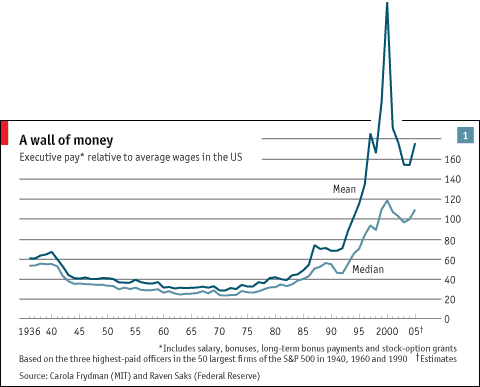
Executive pay vs. relative to average wage in the U.S.
Standard
Executive pay vs. relative to average wage in the U.S.

Executive pay vs. relative to average wage in the U.S.

According to Andrew Sullivan, we should acknowledge success more.

Why are so many on the left incapable of acknowledging that many people who are rich – but, of course by no means all of them – earned it the hard way

via “The Successful” – The Daily Dish | By Andrew Sullivan.

It’s because many (not some) of them are still grossly overpaid and their largess serves as a drain on the earning potential of every employee in their company. Let’s look at Meg Whitman’s success:

Her worst decision at eBay — to buy internet phone service Skype for over $4 billion in 2005 — bled billions in eBay’s value. It was a huge waste of money whose consequences were passed on to employees and shareholders. The effects are still being felt by the company today, over five years after Whitman’s disastrous decision.

Whitman’s fabled $1 billion in wealth was acquired in the first few months of her tenure, well before she could muck the company’s bottom line up. That billion-plus that eBay’s directors handed Whitman was perhaps the easiest billion anyone has ever been handed in corporate history: eBay hired Whitman in March 1998, when the company was already the tech world’s darling. Just six months after she joined, eBay went public, making Meg Whitman an overnight billionaire thanks to stock options that allowed her to buy eBay stock at just 7 cents a share, and sell them on the market for as high as $170 per share.

via How Meg Whitman Failed Her Way to the Top at eBay, Collecting Billions While Nearly Destroying the Company | News & Politics | AlterNet.

We shouldn’t assume that wealth means success. The real problem here is executive pay in publicly traded companies. Many are overpaid vs. the real performance of their company under their leadership.

To add to the grievance, many executives did not seem to deserve such rewards. Extraordinary pay for great performance is fine, it is routinely said. But many executives have been paid a fortune for presiding over mediocrity. The Corporate Library, an American corporate-governance consultancy, last year identified 11 large and well known but poorly governed companies, including AT&T, Merck and Time Warner, where the chief executive had been paid at least $15m a year for two successive years even as the company’s shares had underperformed. Robert Nardelli received a $210m pay-off when he lost his job earlier this month even though the shares of his company, Home Depot, fell slightly during his six years in charge. Carly Fiorina, ejected from Hewlett-Packard almost $180m better off—including a severance payment of $21.6m—after a lacklustre tenure as chief executive, let it be known in her autobiography that money was not important to her. Not everyone believed her.

via A survey of executive pay: In the money | The Economist.

Some US and British executives are overpaid vs their peers from other nations within their own industry:

It has not only revealed a few high earners (a source of shame in Japan), but exposed wide divergences in pay, especially between Japanese nationals and a few foreign star executives. For example Nissan’s boss, Carlos Ghosn, earned around $9.5m last year—one hundred times the pay of Masamoto Yashiro, the departing boss of Shinsei Bank, who took home just $95,000. Sir Howard Stringer of Sony received more than $8m if stock options are included. His counterpart at Panasonic earned a modest $1.2m. Takeda Pharmaceutical paid its America-based global sales chief $6m, twice as much as its chief executive back in Japan.

Four non-Japanese executives of Shinsei Bank, which is around a quarter owned by the state following a bail-out in the late 1990s, have been forced out, in large part because of their seemingly outsized pay packages, which exceeded the $1m disclosure limit. Among them was the chief financial officer, Rahul Gupta, despite his having managed to increase the bank’s capital-adequacy ratio last year even as the bank suffered losses of more than $1.5 billion. Furthermore, the Shinsei executives’ pay was determined by an independent compensation committee of the board, unlike that of most of their Japanese peers.

via Japanese executive pay: Spartan salarymen | The Economist.

Whitman’s leadership was a cash drain on E-Bay. She was a huge wealthy failure. Same with Fiorna who boosted earnings by bleeding out talent with layoffs, not by improving HP. Let alone departing executives at Bear Sterns and Lehman Brothers, the US Auto makers and countless other organizations. When people don’t acknowledge the wealthy, it may be because they only are good at harnessing wealth for themselves. US executives have (on average) the largest disparity of yearly earnings vs. their workers of any industrialized nation. Sullivan needs to acknowledge that we need to be better at judging success before we applaud it.

I Want My Country Back!

Standard

…And so does Transpo Secretary Ray LaHood (as found on Atrios):

This is something I’ve never really talked about, but growing up, I lived on the east side of Peoria. When I was growing up, I could walk to my grade school. We had one car, but we would bike everywhere we went. We could walk to the grocery store. In those days, we had streetcars and buses, which people used to get to downtown Peoria, which was probably five miles from my house. I used to take a bus to my dad’s business. I grew up in an era [of] livable neighborhoods and livable communities — what we’re really trying to offer to people around America. When there was no urban sprawl, when you didn’t have to have three cars, when there weren’t houses with three-car garages, everybody had one car.

via Transportation Secretary Ray LaHood talks about livable communities | Grist.

LaHood was born in 1945 in Peoria, Illinois (pop. 105,187 in 1940 to pop. 126,963 in 1970) and turned 18 in 1963. LaHood is describing a working, middle class city built for working class budgets where it is easy for working class people to get to and from work.